Nautical Summer Beach Tumbler Wrap: A Designer's Review
As a designer who spends more time staring at stitch maps and thread charts than I do enjoying the actual summer season, I approach every new digital embroidery file with a mix of curiosity and skepticism. When I first pulled up the Nautical Summer Beach 20 Oz Tumbler Wrap, my initial reaction wasn't about the sublimation potential—though that is clearly the primary intent given the high-resolution PNG format—but rather how these graphics translate into the tactile world of machine embroidery design. We often see Tumbler Wraps marketed strictly for heat transfer or UV printing, but there is a growing trend among Etsy sellers and boutique owners to hybridize these assets. The question I asked myself immediately was: Can this specific graphic layout survive the needle and thread treatment, or is it destined to remain a flat image?
The Visual Personality and Layout Potential
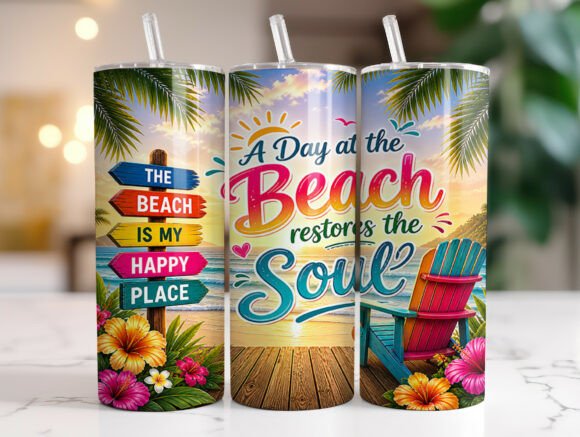
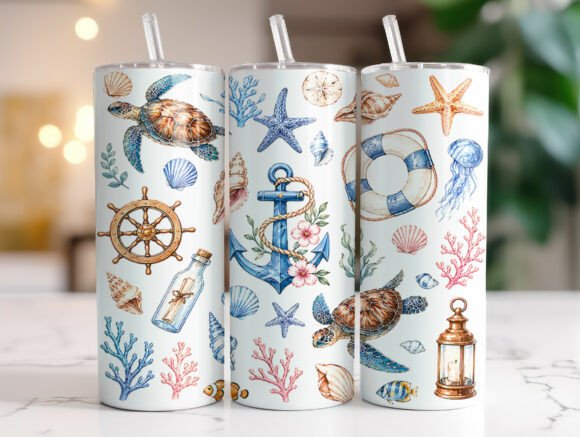
The first thing that strikes you about the Nautical Summer Beach 20 Oz Tumbler Wrap is its mood. It captures that quintessential coastal vibe without feeling cluttered. The composition, sized at 9.3″ x 8.2″, offers a generous canvas. In the world of Graphics, this resolution of 300 DPI is solid for printing, but for us as embroiderers, it serves as an excellent reference map. The design likely features classic nautical elements—perhaps anchors, waves, or beach typography—that rely on clean lines and distinct color blocks. This is crucial because when you are converting a printed concept into a stitched reality, you need clear separation between elements to define your satin stitch borders and fill stitch areas.
From a layout perspective, the "straight" and "tapered" versions included in the download suggest a flexibility that we can borrow for apparel. While the tapered version is engineered for the curve of a skinny tumbler, the straight version is a goldmine for flat custom apparel. Imagine taking those nautical motifs and re-arranging them for a tote bag design or a large back patch on a denim jacket. The visual personality screams "vacation mode," making it an ideal candidate for seasonal collections where customers want to feel the ocean breeze even when they are inland.
Real-World Application: The Boutique Sweatshirt Scenario
Let's move from theory to a real-life scenario. Picture a small shop owner preparing for a summer craft fair. They have a line of oversized, heather-grey sweatshirt embroidery pieces they want to launch. Instead of creating a design from scratch, they use the Nautical Summer Beach 20 Oz Tumbler Wrap as a visual foundation. By tracing the key elements in their digitizing software, they can create a custom applique design that mimics the wrap's aesthetic.
In this scenario, the large scale of the original graphic allows the designer to isolate specific components. Perhaps just the central beach motif is used for a left-chest logo, while the full wave pattern becomes a hem detail. The result is a cohesive handmade product that feels professional and branded. Customers interacting with this finished product aren't thinking about the source file; they are reacting to the texture of the threads and the quality of the construction. If the original graphic has strong contrast, the resulting embroidery will pop against the fabric, increasing the perceived value of the item. This kind of strategic adaptation is what separates a hobbyist from a serious craft business operator.
Fabric Considerations and Stitching Challenges
However, we must be realistic about where this design shines and where it might struggle. Translating a high-detail PNG into stitches requires careful planning regarding stitch density. Nautical themes often involve water effects or gradients which, in embroidery, can become muddy if the thread colors are too similar or if the stitch count is too high for the base material. If you attempt to stitch this on a thin, stretchy fabric like a lightweight t-shirt without proper stabilization, you risk puckering. The density required to capture the detail of a 300 DPI image could weigh down the fabric, ruining the drape of the custom apparel.
Furthermore, consider the hoop size. The original dimensions are quite large (over 9 inches wide). Most standard home embroidery machines have a maximum hoop size of 5x7 or 6x10 inches. To execute this as a full-scale embroidery project, you would need a multi-position hoop strategy or a commercial machine with a larger field. For smaller applications, like a baby embroidery project on a onesie or a cap, you would need to significantly scale down the design. This is where the "tiny lettering" warning comes into play. If the wrap includes small text detailing a beach name or date, shrinking it for a hat might render it unreadable once stitched. In such cases, simplifying the design or removing the text entirely is often the smarter creative choice.
Enhancing Brand Value and Customer Trust
Why go through the trouble of adapting a tumbler wrap for embroidery? It comes down to brand consistency and perceived quality. A customer who sees a matching set—a sublimated tumbler and an embroidered tote bag featuring the same Nautical Summer Beach theme—perceives a higher level of professionalism. This consistency builds trust. It tells the buyer that the Etsy seller or boutique owner pays attention to detail. The tactile nature of embroidery adds a layer of luxury that flat prints cannot match. When a customer runs their hand over a well-digitized embroidered patch or a satin-stitched anchor, the sensory experience reinforces the idea of a premium personalized gift.
Moreover, using established graphics like this as a base for embroidery can speed up your production time for holiday embroidery rushes or wedding gifts. Instead of starting from zero, you are iterating on a proven visual concept. This efficiency allows you to focus on the stitching quality and fabric selection, which are the true drivers of customer satisfaction.
Practical Notes for the Working Designer
Before you commit to stitching this design onto a client's garment, there are several practical steps you must take. First, never skip the test run. Use scrap fabric that matches the weight and texture of your final material. Check how the stabilizer interacts with the fabric; for dense nautical fills, a cut-away stabilizer is often safer than tear-away to prevent distortion after washing.
Second, evaluate the color palette. Screen colors on a PNG do not always translate perfectly to thread charts. A vibrant digital blue might look dull as rayon thread. Compare your digital mockup against physical thread swatches. It is also wise to test the design in black and white to ensure the contrast holds up without relying on color differentiation. This is particularly important for commercial embroidery projects where logos must be recognizable even in monochrome applications.
Finally, and perhaps most importantly, review the licensing terms. The product description states this is an instant download with no physical product shipped, intended as a graphic asset. Using a PNG file designed for sublimation as a reference for embroidery is generally acceptable for creating derivative works, but reselling the digitized file itself or claiming the original artwork as your own may violate the creator's rights. Always confirm whether the license permits use in small shop products and commercial finished goods. Clear communication and adherence to licensing protect your reputation and ensure your design assets remain a source of income rather than legal trouble.
In conclusion, the Nautical Summer Beach 20 Oz Tumbler Wrap is more than just a print file; it is a versatile visual resource. With thoughtful adaptation, respect for fabric limitations, and careful digitizing, it can transform from a simple tumbler graphic into a stunning array of embroidered treasures, from cozy sweatshirts to chic tote bags, ready to delight customers and elevate your brand.